
Publications
|
A V Krishnan A Methodological Framework for Strategic Electricity Generation Planning in India: Assessing Resource Adequacy Through Probability Risk Metrics https://link.springer.com/chapter/10.1007/978-981-95-3389-3_32 Das, S.S., Majumdar, R., Krishnan, A.V., Srikanth, R. (2026). In: Renewable Power for Sustainable Growth: Proceedings of ICRP 2024 (Volume 2); Lecture Notes in Electrical Engineering (LNEE) Series, Springer (pp. 371–392). This study discusses a methodological framework in conjunction with the existing probability-based risk metrics for assessing the resource adequacy of the electricity generation mix, considering the generation capacities of different sources, their average availability levels, and the possible outages that these sources may suffer from. The simulations show that the available capacity decreases with an increasing number of discrete risk events, which limits the capability of the power system to meet the demand. For a 2-day test simulation (considering a loss of load expectation value of 2 event-days), the loss of load event is found to be 4 events, and the expected unreserved energy is estimated to be 1400 MWh over the predefined, representative 2-day period. |
|
Rudrodip Majumdar A Methodological Framework for Strategic Electricity Generation Planning in India: Assessing Resource Adequacy Through Probability Risk Metrics https://link.springer.com/chapter/10.1007/978-981-95-3389-3_32 Das, S.S., Majumdar, R., Krishnan, A.V., Srikanth, R. (2026). In: Renewable Power for Sustainable Growth: Proceedings of ICRP 2024 (Volume 2); Lecture Notes in Electrical Engineering (LNEE) Series, Springer (pp. 371–392). This study discusses a methodological framework in conjunction with the existing probability-based risk metrics for assessing the resource adequacy of the electricity generation mix, considering the generation capacities of different sources, their average availability levels, and the possible outages that these sources may suffer from. The simulations show that the available capacity decreases with an increasing number of discrete risk events, which limits the capability of the power system to meet the demand. For a 2-day test simulation (considering a loss of load expectation value of 2 event-days), the loss of load event is found to be 4 events, and the expected unreserved energy is estimated to be 1400 MWh over the predefined, representative 2-day period. |

|
Biju Dharmapalan Essential negotiation skills while moving from research to industry https://www.thestatesman.com/books-education/essential-negotiation-skills-while-moving-from-research-to-industry-1503561777.html The Statesman It’s taken for granted that every researcher, after their PhD, moves to academics. Very few are interested in moving into industry. |
|
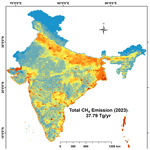
Gufran Beig A gridded (0.1° × 0.1°) methane emission dataset for India for 2023 to redefine global climate studies https://essd.copernicus.org/articles/18/1367/2026/ Mishra, A., Mangaraj, P., Sahoo, P., Beig, G., Janardanan, R., & Sahu, S. K. (2026). A gridded (0.1°× 0.1°) methane emission dataset for India for 2023 to redefine global climate studies. Earth System Science Data, 18(2), 1367-1378. |

|
M Sai Baba Social Theoretic Modeling and Simulation Study of Trust and Interoperability in Social Internet of Things (SIoT) https://ieeexplore.ieee.org/abstract/document/11393069 Chidambaram, G., Subbarayappa, S., & Sai Baba, M. (2025, December 18-20). Social theoretic modelling and simulation study of trust and interoperability in Social Internet of Things (SIoT). IEEE 22nd India Council International Conference (INDICON), Bengal |

|
C P Rajendran NGT greenlit a megapolis on seismically dangerous land. Greed beat science https://frontline.thehindu.com/environment/ngt-great-nicobar-strategic-environmental-clearance-controversy-india/article70655209.ece Frontline Post-tsunami measurements proved that Great Nicobar subsides without warning. The island sits on an active subduction zone that sinks during quakes. Geologists have documented it, but the tribunal ignored it. |

|
Sanjay Kumar Srivastava Shared Waters, Shared Futures: Sahabhagita and Cooperative Governance in the Bay of Bengal https://cms.nias.res.in/sites/default/filesefs/2026-03/Shared%20Waters%2C%20Shared%20Futures.pdf Tariṇi: Sailing Across the Bay of Bengal, Issue No 1, pp 5-6, Nalanda University and Ministry of External Affairs, India, The Bay of Bengal is one of the world’s most climate-vulnerable regions. The Ganges–Brahmaputra–Meghna basin sustains nearly 700 million people, yet fragmented water governance costs the region over USD 14 billion annually in disaster losses and missed development opportunities. By reframing rivers and seas as shared commons, Sahabhagita – a framework of cooperation- highlights how regional cooperation can strengthen resilience, reduce risk, and build a more stable and prosperous Bay of Bengal future.
|

|
Gufran Beig Age Specific Exposure of Particulate Matters (PMs) Under Extreme Event in Three Different Cities of Western India https://link.springer.com/article/10.1007/s41810-026-00376-x Bano, S., Anand, V., Mukherjee, A. et al. (2026). Age Specific Exposure of Particulate Matters (PMs) Under Extreme Event in Three Different Cities of Western India. Aerosol Science and Engineering. |