
Publications

|
N C Narendra NeuroChaos-inspired edge intelligence for resource allocation in 5G/6G vehicular networks https://www.preprints.org/manuscript/202610.0953 Raghavendran, T. S., Ahmed, S. T., & Narendra, Nanjangud C. (2026). NeuroChaos-inspired edge intelligence for resource allocation in 5G/6G vehicular networks. Preprints. 5G Advanced and 6G V2X Environments require intelligence that is real-time, resource-light and robust across high-density vehicle mobility, non-stationary channels and hard ware constrained edge nodes. Existing AI-driven resource man agement approaches — including CNNs, LSTMs, GNNs, Deep Reinforcement Learning, Transformers, and Federated Learning — have limitations, such as high computational overhead, large data requirements, poor generalization under topology churn, and catastrophic forgetting under continuous retraining. These limitations render them ill-suited for deployment, especially at the level of radio units. To address this issue, this paper proposes NeuroChaos-V2X, a chaos-inspired edge intelligence framework that integrates vehicle mobility, wireless channel, and edge computing states into a unified multi-domain state vector. A Neu roChaos Feature Transformation module, employing GLS and Logistic-map neurons, converts raw network measurements into chaos-derived descriptors — firing time, firing rate, energy, and entropy — without requiring deep architectures or large training datasets. These features drive a unified NeuroChaos Decision Engine supporting edge server selection, task offloading, resource prioritization, and handover management simultaneously. The framework’s low-sample learning capability, CPU-only footprint, and sensitivity to small state perturbations make it inherently suited to resource-constrained V2X edge tiers. This position paper establishes the conceptual foundation and motivates experimental validation against GNN, DRL, and Transformer baselines in future 6G-V2X simulation environments. |
|
G Parthasarathy Spectroscopic methods in crtical minerals exploration and characteization: Recent advances and future perspectives https://ins-india.org/pdf/Brochure_CMEC.pdf Parthasarathy, G. (2026, October 8-10). In Proceddings of the AMD-INS International Symposium on Critical Minerals and Materials as Elements of Change: A Global Perspective. Hyderabad, India. pp.183. CMEC 54. |
|
|
G Parthasarathy Lithium –bearing LCT pegmetites of the Amreshwar and Mangalur. Eastern Dharwar cratorn, India. A comparative geochemical perspective https://ins-india.org/pdf/Brochure_CMEC.pdf Parthasarathy, G., et al. (2026, October 8-10). In Proceddings of the AMD-INS International Symposium on Critical Minerals and Materials as Elements of Change: A Global Perspective. Hyderabad, India. pp.134-135. CMEC 23. |
|
|
G Parthasarathy Evidence for unusually high lithium concentrations in paleoproterozoic vempalle dolostones: First report of zabulite from the Cuddapah basin South India https://ins-india.org/pdf/Brochure_CMEC.pdf Parthasarathy, G., et al. (2026, October 8-10). In Proceddings of the AMD-INS International Symposium on Critical Minerals and Materials as Elements of Change: A Global Perspective. Hyderabad, India. pp.36. CMEC-17. |
|
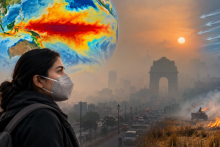
Gufran Beig When weather becomes a pollution multiplier, Delhi needs a strategy beyond the city https://indianexpress.com/article/opinion/columns/weather-pollution-delhi-strategy-city-aqi-pollution-10912730/?ref=opinion_hp When weather becomes a pollution multiplier, Delhi needs a strategy beyond the city. The Indian Express. |
|
Gufran Beig Godzilla El Nino shadow over Delhi’s winter air https://www.timesnownews.com/opinion/india/godzilla-el-nio-shadow-over-delhis-winter-air-article-156289714 Beig, Gufran. (2026, October 07). Godzilla El Nino shadow over Delhi’s winter air. Times Now. |

|
Sanjay Kumar Srivastava Nepal Floods: The Mountain Sent a Signal https://cms.nias.res.in/sites/default/filesefs/files/about/Surakshit%20Sansar%20SEPTEMBER%202026%20e_version%20%281%29.pdf Srivastava, Sanjay Kumar (2026). Nepal floods: The mountain sent a signal. Surakshit Sansar, 23–28. |

|
Sanjay Kumar Srivastava Climate-Induced Loss and Damage at 2°C: Economic Risk and Inequality in India https://www.primeopenaccess.com/scholarly-articles/climateinduced-loss-and-damage-at-2c-economic-risk-and-inequality-in-india.pdf Srivastava, Sanjay Kumar (2026). Climate-Induced Loss and Damage at 2°C: Economic Risk and Inequality in India. Lett Econ Res Updates, 2(3), 01-09. |