
Publications
|
Supriya RoyChowdhury The political economy of labor informality in India: trends, theories, and politics https://ideas.repec.org/h/elg/eechap/19739_49.html in: Maurizio Atzeni & Dario Azzellini & Alessandra Mezzadri & Phoebe Moore & Ursula Apitzsch (ed.), Handbook of Research on the Global Political Economy of Work, chapter 49, pages 581-590, Edward Elgar Publishing. |
|
Anant Kamath ASSISTANT PROFESSOR, Inequality and Human Development Programme Book Review of Mapping Scientific Method: Disciplinary Narrations https://journals.sagepub.com/doi/10.1177/00699659231209662 Kamath, A. (2023). Book review: Gita Chadha and Renny Thomas, ed. 2023. Mapping Scientific Method: Disciplinary Narrations. Contributions to Indian Sociology, 57(1-2), 147-149. |
|
Aleena Sebastian Women and the invisible gender terrain of armed resistance in India https://www.routledge.com/Maoist-Insurgency-State-and-People-Overlooked-Issues-and-Unaddressed-Grievances/Behera/p/book/9781032454252 In: Maoist Insurgency, State and People: Overlooked Issues and Unaddressed Grievances (Edited by Anshuman Behera ). Routledge. ISBN 9781032454252 The gender dimension of armed conflict is marginal in the scholarship on Peace, Conflict, and Security Studies and requires further engagement through a feminist lens. It disrupts the notion that participation in these movements helps women escape patriarchy, and raises questions about the ‘ambivalent emancipation’ in India’s ‘Red Corridors.’ Through a historical and contextual reading of various resistance movements in South India and West Bengal, this paper explores how women navigate and negotiate varied socio-cultural and gender norms around women’s participation in the conflict. This reading is beyond the notion of women in conflict as passive participants or victims. |

|
Carol Upadhya Caste and Capital https://global.oup.com/academic/product/the-oxford-handbook-of-caste-9780198896715?lang=en&cc=ci In: The Oxford Handbook of Caste. Oxford University Press. ISBN 9780198896715 The chapter explores the historical and contemporary entanglements of caste and capital accumulation in India, drawing mainly on sociological literature. |
|
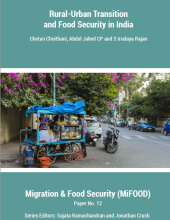
Chetan Choithani Rural-Urban Transition and Food Security in India (MiFood Paper No. 12). Working Paper https://93dfc2.p3cdn1.secureserver.net/wp-content/uploads/2023/07/MiFOOD12.pdf?time=1689954236 Co-Authored with Abdul Jaleel CP and S Irudaya Rajan, The Hungry Cities Partnership at the Balsillie School of International Affairs, Waterloo, Ontario, Canada. |

|
Anitha Kurup Outcome-based Education as Janus-faced Travelling Theory: Appeal for a Broader Research Agenda https://journals.sagepub.com/doi/10.1177/23476311231173486 Co-Authored With Debarun Sarkar. Higher Education for the Future 10(2) 139–152. A shift towards outcome-based education (OBE) is visible in an emerging set of educational policy and regulatory documents and higher education institutions across the country. The article argues for OBE to be approached through the lens of ‘travelling theory’ to foreground the process of translation across various scales, from the transfer of policy knowledge to negotiations in the classroom. By doing so, the article highlights the process of translation which remains at the core of OBE, as it tends to mobilize both managerial and behaviourist approaches along with a constructivist and constructionist approach. The popularity and acceptance of OBE and the disagreements surrounding it are made possible due to this Janus-faced nature of OBE. It argues for acknowledging the mobilization of multiple, contradictory and divergent epistemological approaches as integral to the process of translation of OBE. |

|
Shaima Amatullah, Shalini Dixit Situatedness of School Choice among Muslim Students: An Intersectional Approach https://doi.org/10.1177/09731849231187706 Contemporary Education Dialogue 20(2). So far research on school choice sets (decision about choosing a school from an available set of schools) has primarily regarded parents as key actors. This article emphasises that children are important actors as they inform parental decisions to co-produce certain choice sets. This paper suggest that factors like heterogeneities in social class, differential levels of religious discrimination/exclusion in schools and a need to protect their faith through education and the complex overlap between these were crucial in shaping choices. |

|
Shalini Dixit Dealing with denial of community history: The case of Adivasis in India https://www.routledge.com/Towards-Inclusive-Societies-Psychological-and-Sociological-Perspectives/Tiwari/p/book/9781032216867 Towards Inclusive Societies: Psychological and Sociological Perspectives, Edited By Dharmendra Nath Tiwari, Routledge 2023 This chapter is part of the book Towards Inclusive Societies: Psychological and Sociological Perspectives. The volume focuses on the importance of building inclusive societies and communities for global human welfare within psychological, social, political, and cultural realms. It discusses the engagement of psychology and other social science disciplines on the need for building both cultural sensitivity and interdisciplinary dialogue. |