
Publications
|
Shaik Vazeed Pasha Remote Sensing for Mango and Rubber Mapping and Characterization for Carbon Stock Estimation—Case Study of Malihabad Tehsil (UP) and West Tripura District, India https://link.springer.com/chapter/10.1007/978-981-99-0577-5_9 Co-Authored with V. K. Dadhwal & K. Saketh. In: Chaudhary, S., Biradar, C.M., Divakaran, S., Raval, M.S. (eds) Digital Ecosystem for Innovation in Agriculture. Studies in Big Data, vol 121. Springer, Singapore. |

|
Rudrodip Majumdar Functional Use-Based Positioning of Conventional Vehicles in Conjunction with Alternate Low-Emission Fuels https://link.springer.com/chapter/10.1007/978-981-99-1392-3_5 Co-authored with Kumar Saurabh, Renewable Fuels for Sustainable Mobility Edited by Pravesh Chandra Shukla, et al. Springer, Singapore. It is necessary to consider alternate fuels for ICE-based vehicles to achieve decarbonization in India’s road transport sector. This study discusses the ICE-based alternate fuel options (natural gas, auto-gas and hydrogen) in the light of 28 identified parameters under the 4A framework of energy security, encompassing technical availability, resource availability, infrastructure accessibility, price affordability, social acceptability and environmental acceptability. |

|
Rudrodip Majumdar Thermal stratification characteristics during simultaneous charging and discharging for different storage tank geometries with immersed discharging coil https://www.sciencedirect.com/science/article/pii/S1359431123002648 Co-authored with Hitesh Khurana and Sandip K. Saha. Applied Thermal Engineering Vol, 225: 120235 dictate the efficacy of low-to-medium temperature hot water applications. This study uses a three-dimensional |

|
Gufran Beig, R Srikanth, Shailesh Nayak National Air Quality Resource Framework of India (NARFI) (NIAS/NSE/EECP/U/WR/01/2023) http://eprints.nias.res.in/2500/ Beig, Gufran and Mohanthy, M and Srikanth, R and Nayak, Shailesh (2023) National Air Quality Resource Framework of India (NARFI), (NIAS/NSE/EECP/U/WR/01/2023). Report. NIAS, Bengaluru. Air pollution is serious and most talked about issue in India as impacts are fast realized in a shorter time, unlike climate change. North India including the Indian capital experience extreme levels of pollution during winters due to extreme weather compounded by biomass burning episodes. On the other hand, Western India often witnesses pollution extremes during summer due to intercontinental dust flows whereas the peninsular and east India relatively remain better, but the frequency of weather extremes is increasing, and climate change is impacting the delicate balance. It is resulting in deteriorating health and food security. The problem is well recognized, but information and actions are fragmented warranting an integrated approach to build a resource framework for air quality in a mission mode. Network of specialists working on various aspects of air pollution and knowledge sharing for optimal and broad-scale results that benefit all. To address this gap, the National Institute of Advanced Study (NIAS, IISc Campus, Bengaluru) organized the brainstorming workshop for stakeholders along with the office of Principal Scientific Advisor to Govt. of India to help develop pathways for dialogue and knowledge sharing for air pollution information, alerts, capacity building, effective mitigation, and policy at the national level. The current strategic document is an outcome of this effort. This NARFI aims to build an integrated framework in air quality for a sustainable future by bringing together researchers, practitioners, and experts from diverse sectors and disciplines – air quality monitoring, health, and social inclusion, livelihoods, knowledge management, and communication, as well as those dealing with open burning, transport sectors, etc. Also, regional pollution issues like stubble burning, smog, and fog –to share their knowledge and experience on air pollution. The framework will support the public-industry partnership in air quality management that has the potential to influence decision-makers. |

|
Sayan Banerjee, Anindya Sinha Reading the elephant: Affective conceptualisations of the wild Asian elephants Ecological entanglements: Affect, embodiment and ethics of care (eds.Ambika Aiyadurai, Arko Chattopadhyay, Nishaant Choksi) Orient Black Swan, The chapter talks about how people ‘read’ wild elephants’ lives affectively to engage with both elephant and human lives. |

|
Vinay Kumar Dadhwal Implications of Emission Sources and Biosphere Exchange on Temporal Variations of CO2 and δ13C Using Continuous Atmospheric Measurements at Shadnagar (India) https://agupubs.onlinelibrary.wiley.com/doi/abs/10.1029/2022JD036472 Co-Authored with Pathakoti M., Kanchana AL. and et.al. Journal of Geophysical Research: Atmospheres, 128(8), e2022JD036472. |

|
Anindya Sinha Ethos, Pathos, Logos: Affective and Emotive Ethnographies of Human–Macaque Lifeworlds https://orientblackswan.com/details?id=9789354422591 Co-authored with Ishika Ramakrishna and Ajith Kumar In: Ecological entanglements: Affect, embodiment and ethics of care (eds.Ambika Aiyadurai, Arko Chattopadhyay, Nishaant Choksi) Orient Black Swan, 17 April 2023 pp.15-40 |
|
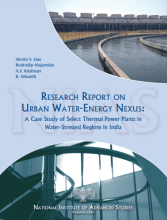
R Srikanth Urban Water-Energy Nexus: A Case Study of Select Thermal Power Plants in Water-Stressed Regions in India (NIAS/NSE/EECP/U/RR/01/2023) http://eprints.nias.res.in/2489/ Das, Sherin S and Majumdar, Rudrodip and Krishnan, AV and Srikanth, R (2023) Urban Water-Energy Nexus: A Case Study of Select Thermal Power Plants in Water-Stressed Regions in India. Report. NIAS, Bengaluru. |