
Publications
|
Dinesh Kumar Srivastava Myriad Ways in Which Things Could Have Gone Wrong but Did Not https://link.springer.com/chapter/10.1007/978-981-99-5005-8_22 In: Chirayath, S.S., Sai Baba, M. (eds) Human Reliability Programs in Industries of National Importance for Safety and Security. Risk, Reliability and Safety Engineering. Springer, 2023 The Variable Energy Cyclotron Center (VECC) at Kolkata has a K130 room-temperature cyclotron that has been operating since 1977, a K500 Cyclotron operating since 2009, a K30 medical cyclotron and a radioactive ion beam facililty. It has a large number of very high voltage or very high current power supplies, liquid helium plants, and very many vacuum pumps sophisticated and delicate equipment. Yet, in the last more than 5 decades of its operation there have been no serious accidents or leakage of radioactivity. This has been possible by a strict regime of retraining and strict adherence to standard security precaution, and an active and understanding leadership. This chapter describes some of these efforts. |

|
R Srikanth Affordable and sustainable transportation: Key drivers and policy choices for a megacity in India https://www.sciencedirect.com/science/article/pii/S2213624X23001153?dgcid=coauthor Co-Authored with Tanmay Ghosh, Tejal Kanitkar. Case Studies on Transport Policy 13: 101061. |

|
Tejal Kanitkar Affordable and sustainable transportation: Key drivers and policy choices for a megacity in India https://www.sciencedirect.com/science/article/pii/S2213624X23001153?dgcid=coauthor Co-Authored with Tanmay Ghosh, R. Srikanth. Case Studies on Transport Policy 13: 101061. |

|
Biju Dharmapalan Harnessing Solar Energy for the Common Man Science India .Vol 19(89): pp. 22-26 |
|
|
Biju Dharmapalan Reaching for the sun Science India .Vol 19(89): pp.09-16 |
|
M Sai Baba Introduction https://link.springer.com/chapter/10.1007/978-981-99-5005-8_1 Human Reliability Programs in Industries of National Importance for Safety and Security published by Springer edited by Sunil S Chirayath and M Sai Baba In any edited volume, the introductory chapter plays an important role. It gives the editor's perspective and introduces the book to the reader. That is what Sunil and I attempted in the chapter "Introduction" in the edited volume titled "Human Reliability Programs in Industries of National Importance for Safety and Security. |
|
M Sai Baba Human Reliability Programme in Industries of National Importance https://link.springer.com/chapter/10.1007/978-981-99-5005-8_9 Human Reliability Programs in Industries of National Importance for Safety and Security published by Springer edited by Sunil S Chirayath and M Sai Baba Accidents fall under two categories: the one, in which the impact is limited to the geographical boundary of the industry and affects the industrial workers and the second, which causes damage to people living in the nearby surroundings and the environment. The HRP is put in place to protect establishments of national importance from human errors and malicious personnel acts. The chapter suggests some approaches to be adopted. |
|
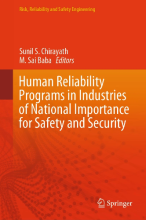
M Sai Baba Human Reliability Programs in Industries of National Importance for Safety and Security https://link.springer.com/book/10.1007/978-981-99-5005-8 Co-Authored With Sunil S. Chirayath. Springer |