
Publications
|
M B Rajani co-authored Associate Professor, Heritage Science and Society Programme Improved geospatial analysis of shoreline modification using a weighted-average-based novel formulation https://onlinelibrary.wiley.com/doi/abs/10.1002/esp.5522 Mohanty, A., Rajani, M. B., Majumdar, R., & Nayak, S. (2023). Improved geospatial analysis of shoreline modification using a weighted‐average‐based novel formulation. Earth Surface Processes and Landforms, 48(5), 863-886. This study presents a novel weighted-average method (WAM) that captures the detailed nuances of shoreline change patterns over long and short periods by considering shorelines belonging to five different time frames. Using the WAM, the average shoreline modification for the longer period (136 years with intervals of ~ 34 years) and for the shorter period (annual changes over a period of 5 years) have been calculated for the 9 km stretch of the Kollam coast in Kerala, India. |
|
Anitha Kurup co-authored Professor, Education Programme Changing Patterns of Work–Life Balance of Women Scientists and Engineers in India https://doi.org/10.1177/09717218221075129 Co-authored with Anjali Raj. Science, Technology and Society, 27(4), 2022 pp.485–501 India has witnessed a steady rise in the number of women scientists and engineers in the last two decades. At the same time, the country has experienced the transition from the joint family to a nuclear family system. This has brought with it unique challenges for the women professionals as they negotiate their roles in families with successful careers. While documenting and analysing the changing patterns of the work–life balance of women scientists and engineers, the article highlights the critical role that the scientific institutions can play as enablers in this process |
|
M B Rajani co-authored Associate Professor , Heritage Science and Society Programme Mapping Archaeological Remains of 14th Century Fort of Jahanpanah Using Geospatial Analysis https://link.springer.com/chapter/10.1007/978-981-19-4136-8_6 Pal, G.K., Rajani, M.B. (2022). In: Mudenagudi, U., Nigam, A., Sarvadevabhatla, R.K., Choudhary, A. (eds) Proceedings of the Satellite Workshops of ICVGIP 2021. Lecture Notes in Electrical Engineering, vol 924. Springer, Singapore. Delhi has been the center of political history for more than a thousand years. The present Delhi is an amalgamation of seven historical cities: Qila Rai Pithora (QPR) (extension of Lal Kot), Siri, Tughlaqabad, Jahanpanah, Firozabad, Dinpanah (Purana Qila), Shahjahanabad. Few of the forts have lost their contours owing to the growth and rapid urbanization of Delhi after India gained independence. |

|
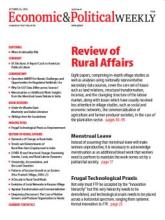
Anant Kamath ASSISTANT PROFESSOR, Inequality and Human Development Programme Beyond a Technological Understanding of Technology https://www.epw.in/journal/2022/46/commentary/beyond-technological-understanding-technology.html Economic and Political Weekly, 57(46): 22-24 |
|
Chetan Choithani co-authored Assistant Professor, Inequality and Human Development Programme Injected Urbanism? Exploring India’s Urbanizing Periphery https://www.tandfonline.com/doi/full/10.1080/00130095.2022.2133696 Co-authored with Robbin Jan van Duijne and Jan Nijman. In: Economic Geography |

|
Ishita Patil co-authored What happened to the Fishing School? Education, Mobility and Perceptions of Well-being in a Traditional Fishing Community in Western India Co-authored with Nitya Rao. Education, Migration and Development |
|
Anant Kamath co-authored Assistant Professor, Inequality and Human Development Programme Towards the Instrumentality of Inequality Co-authored with Debosree Banerjee and Chetan Choithani. Economic and Political Weekly, Vol. 57 What has been the nature of work and discourse on inequality in India? Has it been more anecdotal and ordinal? Does it sidestep the conceptual and refl ective? Is it an elite discourse even within the subaltern? Does it remain blind to both the subtleties and the macro forces that generate, fuel, and reproduce the condition of inequality? And importantly, has it seriously considered the issue of what inequality does to those at the margins? |

|
Chaitanya K co-authored Menstrual Experience of Transmen: A Study of Trauma, Taboo and Concealment http://www.inclusivejournal.in/posts/2022-08-spart-06.html Co-authored with Niyathi R. Krishna. In: Inclusive Journal, Vol. II, July - August 2022 |