
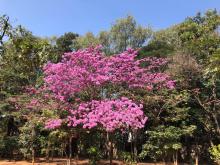
Building Resilience in Southern India's Tropical Forests: Understanding Fire Across Timescales
Speakers : Dr. H. S. Suresh
Visiting Scientist, University of Trans-Disciplinary Health Sciences & Technology (TDU) @ :dr.suresh@tdu.edu.in
Ms. Mithraa Devi
Project Assistant, NIAS @ :mithravijay17@gmail.com
Mr. Nithin Kumar
Project Associate, NIAS @ :nithinkumar@nias.res.in
Dr. Rayees Malik
Assistant Professor, University of Kashmir @ :rayees.ctbo@uok.edu.in
Chairperson : P. Ramya Bala
DST-INSPIRE Faculty @ :pramyabala@nias.res.in
Date : 15th July 2026
Time : 9.30 AM
Venue : Lecture Hall
Abstract: Wildfire is a natural ecological process but changing climate and land-use practices are altering fire regimes worldwide, posing new challenges for biodiversity conservation and forest management. The Mudumalai National Park in southern India burns frequently and yet contains an exceptional diversity of tropical forests, each responding differently to fire. Understanding why these ecosystems burn, how they have changed over time, and how they may respond in the future is essential for developing effective conservation strategies.
Dr. P. Ramya Bala was supported by the Australian Government's Direct Aid Program in Bengaluru under the ‘Women in Tech’ and ‘Agriculture, Climate and Environment’ pillars to develop a multi-institutional collaborative project that combines forest ecology, dendroecology and paleoecology to investigate fire from both modern and long-term perspectives. The research examines fire-related characteristics of living trees, reconstructs climate-growth relationships using centuries-old tree rings and develops India's first comprehensive charcoal reference database for tropical species that lays the foundation for extending fire histories far beyond the period covered by modern observations.
An equally important outcome has been the establishment of new scientific partnerships between India and Australia. Through collaborations with leading Australian universities and participation in international scientific forums, the project has created opportunities for knowledge exchange, researcher training and future joint research on wildfire science, indigenous knowledge systems and ecosystem resilience. By integrating historical records preserved in trees and sediments with present-day ecological observations, the project lays the foundation for how long-term environmental perspectives can inform more resilient forest management in a rapidly changing world. This event marks the conclusion of the DAP grant and is intended to be a dissemination session.
About the speaker: P. Ramya Bala is a DST-INSPIRE Faculty currently working on ‘forest fire-vegetation-human inter-relationships in the past in the tropical dry forests of southern India’ at NIAS. H. S. Suresh is a seasoned botanist and plant ecologist with over 4 decades of field experience who was instrumental in setting up the ForestGEO 50-hectare plot (Global Earth Observatory Network) at Mudumalai National Park. He is currently a Visiting Scientist at The University of Trans-Disciplinary Health Sciences and Technology (TDU). Mithraa Devi is a Botany graduate with a special interest in taxonomy and is a Project Assistant at NIAS. Nithin Kumar is a graduate of the integrated Masters program in Earth Sciences at IISER Bhopal, currently a Project Associate at NIAS and a PhD student at TDU. Rayees Malik is a PhD graduate of the Indian Institute of Science, currently serving as an Assistant Professor at the Department of Botany, University of Kashmir.