
Publications

|
Shaik Vazeed Pasha Historical expansion of tea plantations over 150 years (1876–2023) in North Bengal, India https://link.springer.com/article/10.1007/s10661-024-13208-7 Co-Authored with Vinay Kumar Dadhwal, Komal Kumari & Nashit Ali. Environmental Monitoring and Assessment , Vol.196 The historical expansion of tea agroforestry in North Bengal, India, over the past 150 years (1876–2023) is a fascinating agricultural and economic transformation journey. The region, particularly the Bengal-Dooars area encompassing Jalpaiguri and Alipurduar districts, has seen significant transformations driven by the cultivation of Camellia sinensis (Tea). During the British colonial period, tea estates (TE) rapidly grew due to favourable conditions. The use of remote sensing technology has further facilitated the efficient management and expansion of the Tea agroforestry ecosystem. From an initial 331 hectares, the area under TE expanded to about 95,800 hectares by 2023. New plantations, modern agricultural practices, and technological advancements drove this growth. While tea plantations boosted the local economy and employment, they also impacted the environment, particularly tree cover. Overall, the historical expansion of TE in North Bengal reflects a complex interplay of economic development, agricultural innovation, and environmental change. This transformation remains to shape the region’s landscape and economy today. |

|
Tejal Kanitkar Associate Professor, School of Natural Sciences and Engineering Optimal Power Dispatch with Renewable Energy Integration Using a High-Resolution MILP Model: A Case Study of Western India Thejesh, N., Kanitkar T., Optimal Power Dispatch with Renewable Energy Integration Using a High-Resolution MILP Model: A Case Study of Western India, 16th International Conference on Applied Energy (ICAE2024), 2024 |

|
Joseph Ivin Thomas A Hyperbola Framework for Scalar Diffraction Theory with Applications https://opg.optica.org/abstract.cfm?URI=FiO-2024-JD4A.20 Thomas, J. I. (2024, September). A Hyperbola Framework for Scalar Diffraction Theory with Applications. In Frontiers in Optics (pp. JD4A-20). Optica Publishing Group. A complete geometrization of the Huygens–Fresnel principle by means of a highly versatile hyperbola theorem is presented, alongside its applications. The unitary framework so developed can concurrently apprehend both optical interference and diffraction phenomena. |

|
Anindya Sinha co-authored Professor, School of Natural Sciences and Engineering Human-animal interactions: Camera traps as research agents https://rai.onlinelibrary.wiley.com/doi/10.1111/1467-8322.12905 Co-Authored with Lainé, N., Simenel, R., Labadie, M., & Srinivasaiah, N. M., (2024). Human‐animal interactions: Camera traps as research agents. Anthropology Today, 40(4), 22-26. Over the past two decades, technological advancements have significantly increased image-based methodologies, particularly the use of camera traps, which have become invaluable tools in ecology for examining a wide range of phenomena, including animal activity patterns, habitat selection, abundance, densities and distributions. In this paper, we examine how and why camera traps transform research practices and methodologies, investigate how animals perceive and adapt to these modern technologies, explore the ethical implications of using such devices in animal research and finally, shed light on the complex interplay between technology, animal behaviour and research ethics in the rapidly evolving fields of human–animal interactions and wildlife studies. |
|
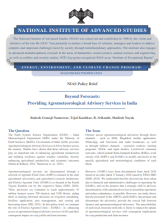
Tejal Kanitkar, Rakesh G Nannewar, R. Srikanth, Shailesh Nayak Associate Professor, School of Natural Sciences and Engineering Beyond Foreasts: Providing Agrometeorological Advisory Services in India http://eprints.nias.res.in/2794/ Nannewar, R., Kanitkar, T., Srikanth, R., Nayak, S., Beyond Foreasts: Providing Agrometeorological Advisory Services in India, NIAS Policy Brief, August 2024 |

|
Tejal Kanitkar Associate Professor, School of Natural Sciences and Engineering A Shift to Solar Irrigation Pump-sets: A Case Study from Uttar Pradesh, India https://doi.org/10.25003/RAS.14.01.0007 Chatterjee, J., & Kanitkar, T. (2024). A Shift to Solar Irrigation Pump-Sets: A Case Study from Uttar Pradesh, India. Review of Agrarian Studies, 14(1), 82-104. |

|
Rudrodip Majumdar NIAS-MECS Project on "An Evidence-based Approach to Access the Energy Transition in Clean Cooking" http://eprints.nias.res.in/2814/ Majumdar, Rudrodip and Kumar, Rajeev (2024) NIAS-MECS Project on "An Evidence-based Approach to Access the Energy Transition in Clean Cooking". Report. NIAS, Bengaluru. |
|
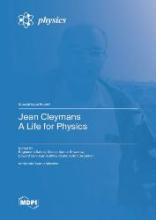
Dinesh Kumar Srivastava Jean Cleymans A Life for Physics https://www.mdpi.com/books/reprint/9504-jean-cleymans-a-life-for-physics Co-Edited with Raghunath Sahoo, Edward Sarkisyan-Grinbaum and Airton Deppmann. MDPI Books, Basel, Switzerland This special issue memorial volume is dedicated to the late Professor Jean Cleymans, who made a visible contribution to high-energy nuclear physics and the search for the primordial matter of quarks and gluons, called quark-gluon plasma (QGP). An extraordinary scientist, educator and motivator, Prof. Cleymans, is known for his fundamental contributions to describing the matter created in ultra-relativistic heavy-ion collisions for the creation of QGP in the laboratory, using a two-parameter statistical hadron resonance gas model, which accurately describes and predicts the abundance of different hadronic species and their transverse momentum distributions along with providing a robust confirmation of thermal and chemical equilibrium of the process of particle production. This memorial volume has scientific contributions from stalwarts in the field, who were extremely fortunate and privileged to have a Colleague and Collaborator like Prof. Cleymans. |